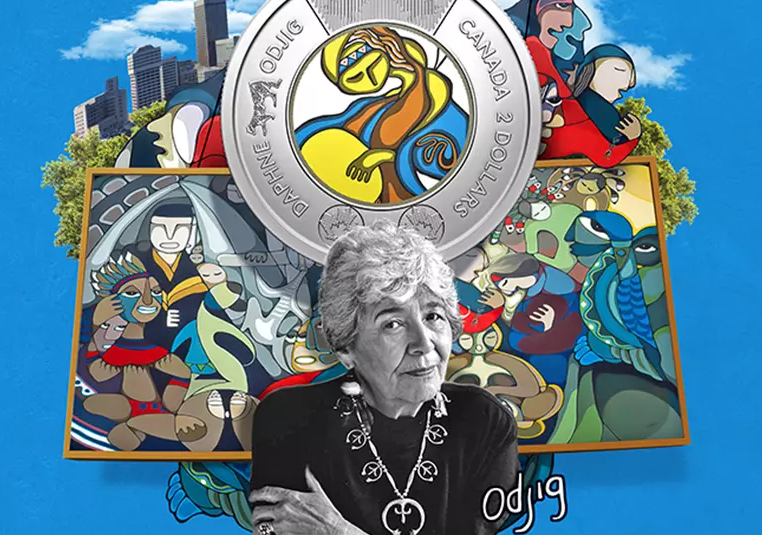
On September 4, 2025, the Royal Canadian Mint officially put a 2 $ commemorative coin into circulation to honor the exceptional life and work of Daphne Odjig. This is a significant milestone, as Daphne Odjig has become the first First Nations artist to have one of her works featured on a Canadian coin!
Who was Daphne Odjig?
Daphne Odjig was born on September 11, 1919, and grew up on the unceded territory of Wiikwemkoong on Manitoulin Island. She passed away in Kelowna, British Columbia, on October 1, 2016, at the age of 97. She came from a family of artists: her father sketched, her mother sewed, and her grandfather was a stone carver. This environment provided her with the foundation she needed to develop her own artistic passions.
Having grown up during a time in Canadian history when many traditional cultural practices were prohibited by law, she was introduced to art and culture by her grandfather. In her early adulthood, Daphne spent a great deal of time wandering the halls of the Royal Ontario Museum in Toronto, where she taught herself to paint amid the works of Picasso and the Impressionists. The evolution of her artistic techniques and styles reflects her life journey and her deep connection to her cultural identity.
Often described as a «force for change,» Daphne Odjig’s legacy continues to inspire generations of artists. Her unique style blended traditional Indigenous imagery with modernist influences, creating a visual language that accurately expressed the experience of Indigenous peoples in Canada.
The artwork depicted on the coin
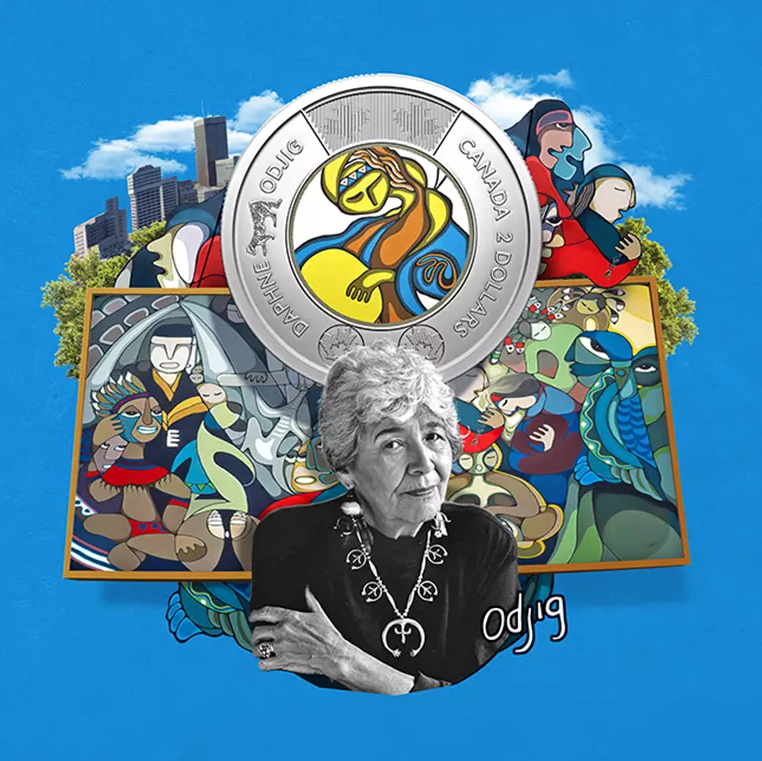
The vibrant and colorful 2 $ coin features one of Daphne Odjig’s most striking works, created in 1977 and titled *The Folk Singer*. The design highlights her striking use of color and her fine, flowing lines, while depicting a woman holding a drum. This work was chosen specifically to underscore her role as a transformative figure in Canadian culture. In Anichinabé culture, the drum represents the heartbeat of the community and can be interpreted as a visual metaphor for resilience and the preservation of Indigenous history.
A subtle yet deeply meaningful detail can be found along the outer edge of the coin: a stylized depiction of a pékan. In 1964, Daphne Odjig had begun calling herself «Daphne Fisher» in an effort to conceal her Indigenous identity. Since «Fisher» is the English translation of «Odjig,» the pékan subsequently became a symbol she used as her signature throughout her career.
Why This Coin Is Important
Daphne Odjig has had a profound influence on First Nations art in Canada and laid the groundwork for the Indigenous artists who followed in her footsteps. A true pioneer and champion of her culture, she has received numerous honors, including the Order of Canada in 1986, the Governor General’s Award in Visual and Media Arts in 2007, and the Order of British Columbia in 2007. Through her art, she has shared the experiences, stories, and perspectives of First Nations peoples.
The Royal Canadian Mint created this commemorative coin to highlight Daphne Odjig’s lasting influence as an artist and advocate. By featuring her work on a coin in circulation, her story and her art become part of the daily lives of millions of Canadians.
Through this coin, Canada pays tribute to a woman who refused to let her culture be silenced, transforming it instead into a powerful, magnificent, and enduring legacy.